Noticing
the interval.
A curatorial reading of Three distances, an original imagined installation.
An object can organize a room without filling it. A plane changes a route. A suspended surface changes the light. A raised sphere changes the scale of the floor around it.
The edge is an invitation.
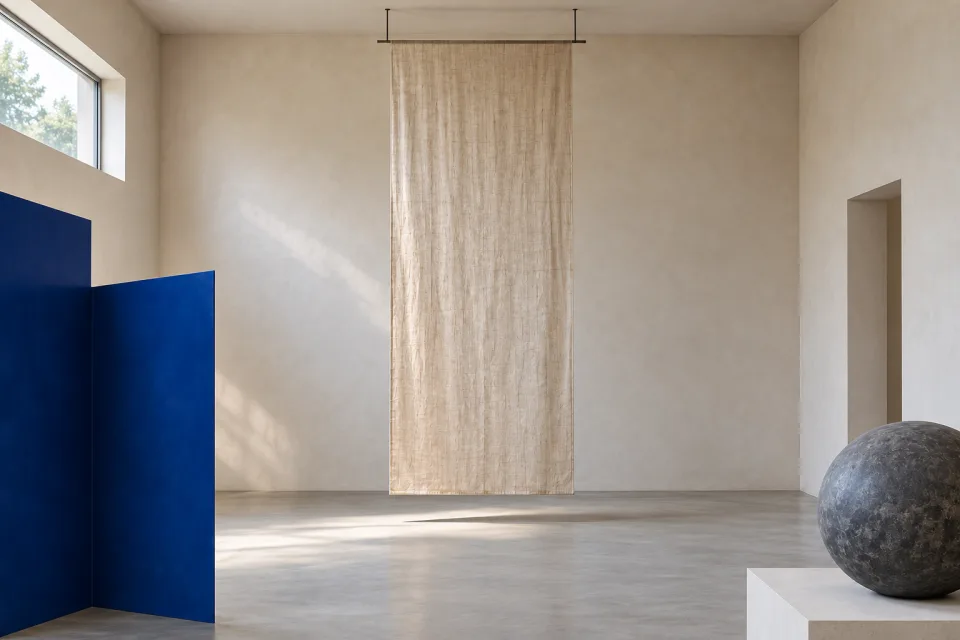
Fold’s two blue planes meet, but do not close a volume. The open angle suggests an inside that remains part of the room. From the entrance it appears as a strong shape; from closer in, the meeting line and unequal heights become more useful ways to read it.
That change is the point of offering related viewpoints. It does not promise a complete or neutral account. A photograph always places the viewer somewhere, and each placement makes some relationships easier to notice.
A boundary need not be opaque.
The linen’s weave lets the wall remain present. Its lower edge is equally important: floor continues underneath the panel. Where the steel redirects a view, the cloth softens it. Neither material has to become a symbol with one fixed meaning.
Contact makes weight visible.
Weight is read through the sphere’s relationship to its pale plinth. The narrow contact between the two surfaces contrasts with the breadth of the base. The image suggests concentration and support; it cannot establish actual mass, fabrication or structural performance.
Leave the question open.
The encounter is not a test with a correct answer. One visitor may attend to light, another to the empty floor. Choose the relationship that holds your attention and bring that question into your visit note.
Return to the room’s three viewpoints