Choose a work to change the actual authored viewpoint and its reading. These are related imagined views, not a navigable 3D model or a documented installation.
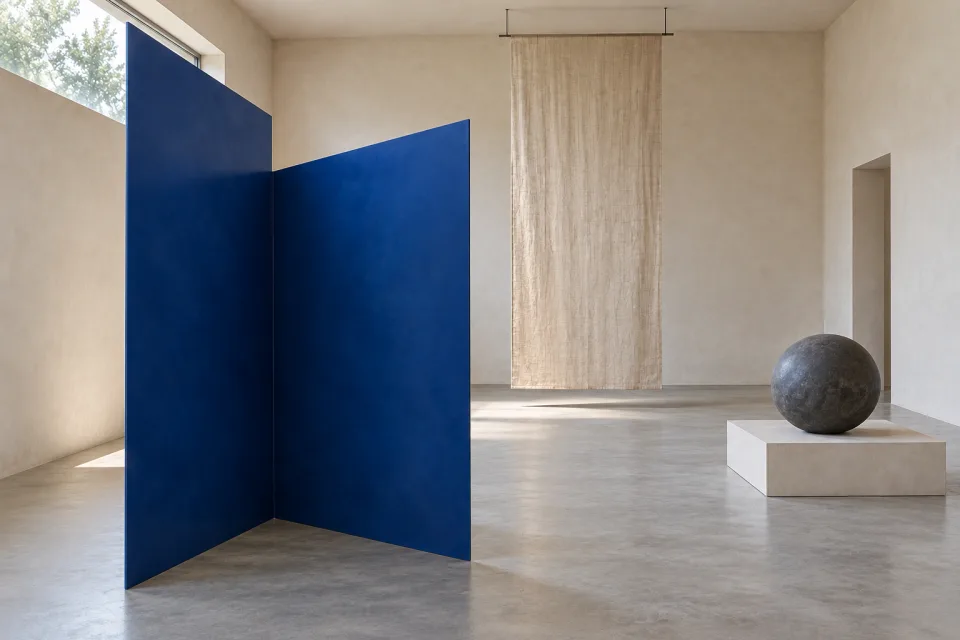
Fold — closer to the open angle. Original imagined exhibition view.
Selected work: Fold
Fold
Imagined painted steel / Left foreground
The fold makes a small inside without enclosing it. From this closer view, the two planes look less like a flat silhouette and more like a threshold. Look along the lower edge: the work shares the floor with the viewer.
Follow the meeting line, then look past the lower blue edge toward the hanging cloth. The boundary and the view beyond it belong to the same encounter.
What will you carry forward?
How does the edge change what I can see beyond it?
Your choices travel in the link. Personal details remain on your device.
Every work, in words.
An accessible reading alternative. Each description stands on its own without viewing or operating the image controls.
Fold
Imagined painted steel / Left foreground
Two unequal blue planes meet at an angle and stand directly on the floor. The taller plane intercepts the window light; the shorter plane leaves a view toward the suspended linen.
The fold makes a small inside without enclosing it. From this closer view, the two planes look less like a flat silhouette and more like a threshold. Look along the lower edge: the work shares the floor with the viewer.
How does the edge change what I can see beyond it?
A single linen panel hangs from a slim bar, leaving a visible gap above the concrete floor. Its weave admits soft light while the panel still interrupts the rear wall.
Suspension is a boundary that can be seen through. The complete cloth and the gap beneath it matter more here than a close crop of its texture. Its weight is held above the floor, unlike the steel and stone.
What does light reveal through a surface that still divides the room?
A charcoal sphere sits on a low, broad pale plinth. Its small contact with the surface sits inside a larger rectangular footprint, leaving visible space around the sphere.
The sphere appears visually concentrated while the plinth spreads its presence across the floor. This is a qualitative reading of the image, not a statement about actual weight, material strength or structural design.
How does the plinth change my reading of weight and contact?