Read all three observations without the contour field
The moving edge
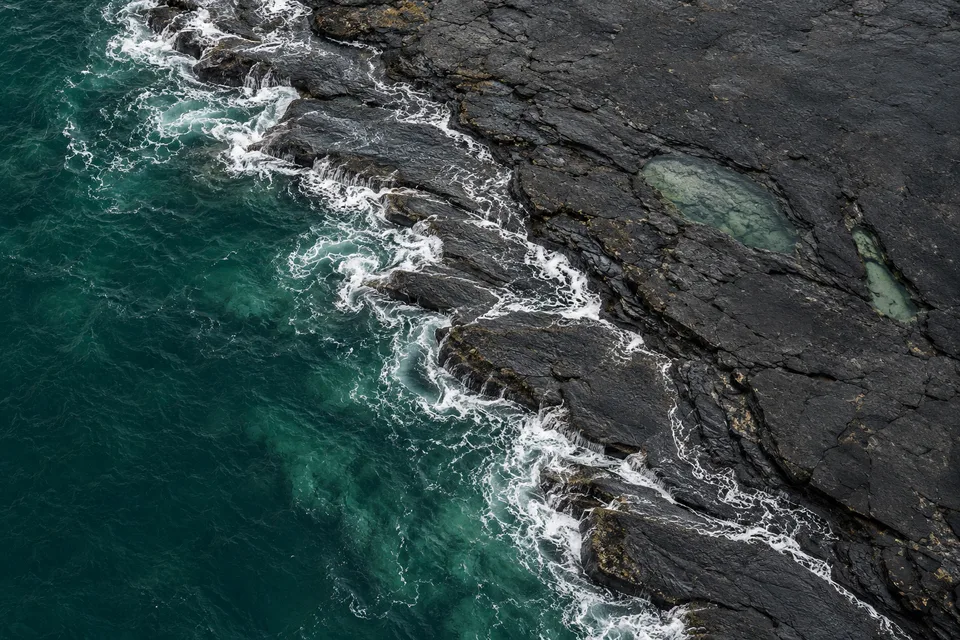
Foam makes a thin, pale seam between open water and the dark shelf. Follow the edge as a changing line rather than a fixed boundary.
The broad view gives the water and rock almost equal weight. Pale foam interrupts the dark material, then thins into threads. The drawn lines gather beside that seam to ask where one surface seems to end and another begins.
The rock holds several edges at once: cracks, shallow steps and wet surfaces. A closer reading asks which lines belong to material, and which to water.
Dark bands run across the shelf without becoming a single continuous border. The drawing gives those interruptions more space. What seems like one surface at a distance becomes a collection of smaller surfaces, each catching the light differently.
A small pool holds a quieter patch of light inside the rock. The surrounding lines turn inward, shifting attention from the long shore to one contained surface.
The pool changes the scale of the story. Its pale surface sits within the dark shelf, while the nearby sea remains open and moving. The nested contours are an authored way of holding attention around that contrast; they do not encode water depth.
Gathered lines suggest close attention; open lines give the relation more visual room. Neither spacing represents a distance or a rate of change.
Stay with a place a little longer.
Tidal develops place stories, reflective publications and concepts for coastal experiences. We begin with the relationship between a landscape and the attention we bring to it.