The last hour belongs to the town
A public room is defined as much by the questions it welcomes as by the tools it holds.
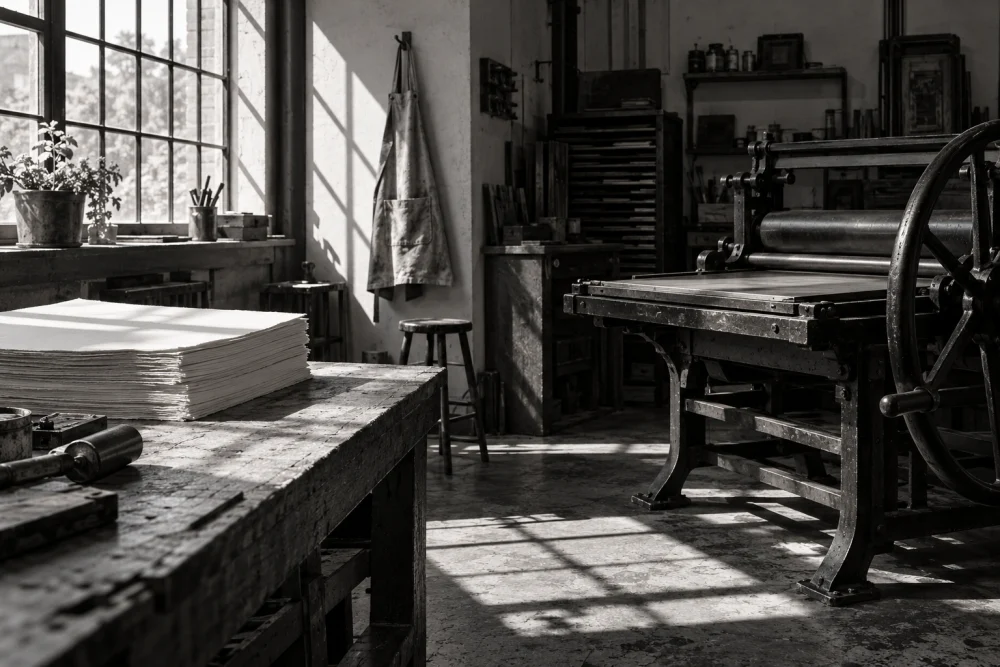
At half past four, the printroom stops being a place for producing something and becomes a place for deciding what deserves to be produced. The public hour has not started yet. A folded shopping trolley waits by the door. On the table are a school play announcement, a lost mitten notice and a map of steps that a visitor could avoid on the way to the river.
In the invented town of Bellwether, this is the most consequential hour in the building’s day. The room’s small proof press is not fast. A home printer would make many of the same sheets with less effort. But speed is not the only thing a public service can offer. Here, someone can ask whether the date is readable before making fifty copies of a mistake.
A room before a machine
The proposal for the room began with an unglamorous problem: people had nowhere to finish small jobs together. A notice needed trimming. A hand-drawn map needed a title. An organizer wanted another person to check that a meeting invitation actually said where to go. None of those tasks justified hiring a studio. All of them benefited from a second pair of eyes.
The imaginary building’s ground-floor room was therefore arranged around a shared table, with the press to one side. That choice mattered. It made the meeting, not the machinery, the center of the plan. Someone could arrive with only a question, sit down and still belong in the room.
A noticeboard by the entrance kept three kinds of information separate: what the room could help with, what visitors needed to bring, and what was beyond its scope. A volunteer could assist with a simple layout, for example, but could not verify a legal announcement or promise that a particular paper would suit every machine. A useful welcome included those limits.
The cost of the last hour
Keeping the door open meant making choices about time as well as materials. A single complicated request could occupy an entire public session. The fictional hosts tried a short first conversation: what is the sheet for, who needs to read it, and what is the smallest useful version? That conversation did not turn the room into a consultancy. It protected everyone’s chance to use it.
The supply cupboard had its own argument. Beautiful paper tempted people to postpone printing until the result seemed worthy of it. A box of ordinary, slightly mismatched stock made experimentation easier. People could test one copy, correct it, and try again. The working sheet became permission to start.
Not every job was appropriate for the room. Large print runs, private records and contentious notices needed different arrangements. The hosts’ response was a clear explanation, not a quiet refusal. The imagined policy made the same distinction the room itself made: public help was a bounded offer, not a promise to solve every printing problem.
What stays on the table
At the end of the public hour, the most interesting artifacts were often the abandoned versions. One invitation had lost a long introduction and gained a clear start time. A map had removed decorative landmarks to make a step-free route easier to follow. A notice about a borrowed ladder now included a way to respond. Each sheet had become more useful by becoming more specific.
Those revisions offer a modest way to think about shared places. Their value does not have to be measured by a dramatic transformation. Sometimes it appears in a small task completed well, a person who knows where to return, or a public message that finally contains the information its reader needs.
Bellwether and its printroom are fictional. The question is open for any reader imagining a real shared resource: what would your room make possible in its last hour, and which limits would help that hour remain generous?