All five complete stories
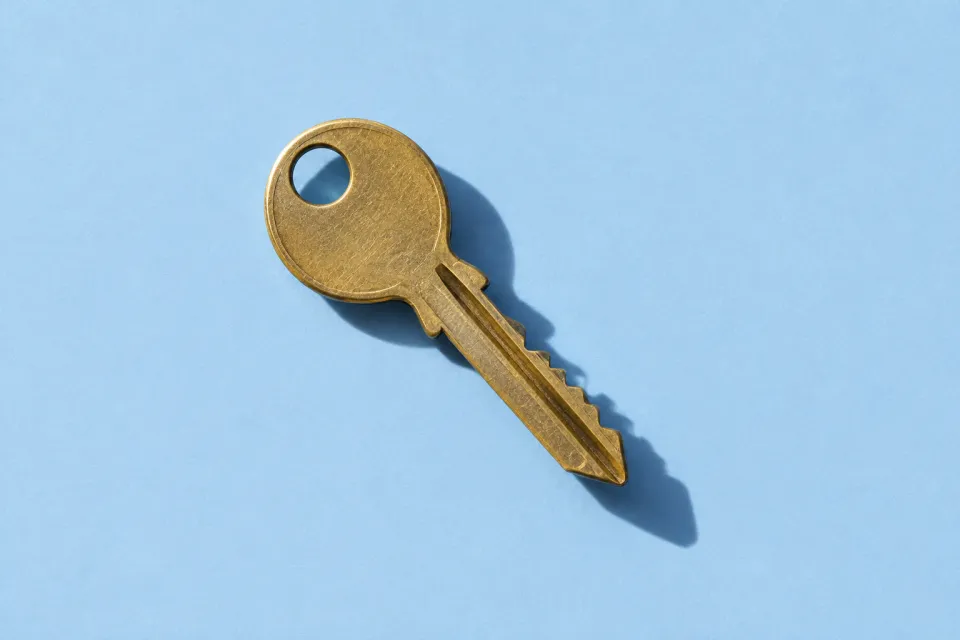
key — The pause before leaving
The hand reaches for the key before the door is pulled shut. It is a tiny rehearsal: thumb through the opening, teeth against a fingertip, the familiar weight accounted for. Nothing has opened yet. The object is doing its first job by being present.
Set on a table, the same key becomes a question. Is it waiting to be picked up, offered to someone else, or left behind on purpose? Its outline gives very little away. The meaning comes from where it rests and who expects to find it.
Imagine a person returning after dark. They know the key by touch and turn it without looking. For that brief moment an ordinary piece of metal stands between outside and inside. Once the door opens, the object becomes almost invisible again. This dictionary lingers at that hinge: not at the achievement of entry, but at the small checking gesture that made leaving possible.
matchbox — What the sleeve keeps
A closed matchbox is almost all surface. The plain blue sleeve gives the hand something to hold while the inner tray moves. Open it a little and the object changes from a block of color into a small inventory. The matches are no longer an idea; they are separate things, each with its own fragile tip.
On a table, the box might sit beside an unlit candle. Nothing needs to happen immediately. Readiness can be a quiet state. Pick the box up and its soft rattle makes the contents audible before they are visible. A container has spoken through the things it contains.
In this imagined scene, the person slides the tray closed again. The moment of interest is not ignition but restraint: the small decision to wait. The sleeve protects what is inside and also hides it. This entry reads that opening and closing as a form of punctuation, a pause between having the means to begin and actually beginning. It is an observation about a container, not an instruction to light a match.
comb — A line, then another
A comb is easy to recognize from its gaps. The spaces between the teeth are as much a part of its shape as the red material itself. Against a pale background the repeated openings make a quiet rhythm. Before it touches hair, the object already suggests a line being drawn.
At a mirror, a hand repeats a movement until something feels settled. The comb is put down, then picked up for one more pass. The difference may be too small for anyone else to notice. That does not make the gesture unimportant. A private standard can be very exact without becoming a measurement.
Later, tucked into a pocket, the comb loses the mirror and keeps the possibility of adjustment. It waits for another small interruption in the day. This invented observation is less interested in a finished appearance than in the repeated return: the hand, the line, the pause to look. The comb is an ordinary tool for making a temporary decision, one that can be undone by wind or sleep or simply changing your mind.
ticket — After the permission
The paper is folded once, small enough to keep without thinking about it. A thumb follows the crease. There are two holes and a thin blue line, but no place or date in this fictional study. The object asks to be read through its handling rather than through information printed on it.
Imagine finding it after the occasion it belonged to. The ticket can no longer admit anyone. Its practical role has ended, while its material form remains. It might become a bookmark, a scrap for a note, or a reminder whose meaning is obvious only to the person who kept it.
On a table beside a spoon, the ticket seems out of place. That small mismatch is useful. One object is expected to return to use; the other may be finished with its original purpose. Both are still here. The dictionary makes room for that uneven afterlife without inventing a history for the paper. The story begins with a crease and asks how long a gesture can remain visible after its reason has gone.
spoon — Between one sip and the next
The bowl catches the light before the handle does. From above, the spoon is a hollow and a line; from the hand, it is a balance between reaching and holding. Its polished surface offers a distorted glimpse of the room without becoming a useful mirror.
In an imagined quiet kitchen, someone stirs a cup and lays the spoon down. The movement has finished, but the object marks where it happened. A small trace on the table may be more noticeable than the tool itself. Ordinary use leaves evidence that is too slight to become an event and too particular to be entirely anonymous.
Pick it up again and the same shape can measure, stir or lift. The dictionary does not decide which job is the real one. Instead it follows the pause between actions, when a tool is neither stored away nor actively used. Here the spoon is a sign that the person may return. It holds that unfinished possibility as lightly as it holds a little liquid.