The chair
we left empty.
At the end of an imagined meeting, one place remained unused. The useful question was not who had failed to arrive, but what the arrangement had asked of them.
An original designed scenario / approximately six minutes to read. No real participants, research findings or external sources are claimed.
Before anyone arrived, we put six chairs around a table. Five had a sheet of paper in front of them. The sixth had nothing. We called it the open place, pleased with the small generosity of leaving something undecided. It was a simple arrangement, and for that reason we treated it as if it needed no explanation.1
Imagine the meeting beginning. Someone chooses the nearest chair. Someone else moves a paper aside to make space for a bag. A late arrival stands briefly at the doorway, looking for the person who might explain what is already happening. The empty chair is visible. Its meaning is not.
An invitation is not a plan.
The chair had acquired a story before it acquired a person. To the people who arranged the room, it meant welcome. To a person arriving later, it might mean that someone else was expected, that the discussion was already full, or that the absence itself was being noticed. None of these readings can be established from the furniture alone.2
An empty place can be an invitation, but it can also be an assignment nobody agreed to take.
The imagined host could resolve this with a sentence: that place is available if it is useful to you. The sentence matters because it gives a person something the object cannot: a way to decline without appearing to refuse the meeting. The offer becomes smaller and more precise.
A place to begin.
The first useful question was not where everyone should sit, but what a late arrival would need to understand.
A title on the paper might tell them what the conversation concerns. A short spoken introduction might explain what has been decided and what remains open. A visible route to the table might make joining physically easier. These are different kinds of information, and no single gesture can stand in for all of them.3
It is tempting to call the arrangement inclusive because it contains an unoccupied chair. In this essay, that word would arrive too early. We have not described the doorway, the route, the sound in the room, the forms of participation or the needs of anyone attending. A label would close a question the scenario has not answered.
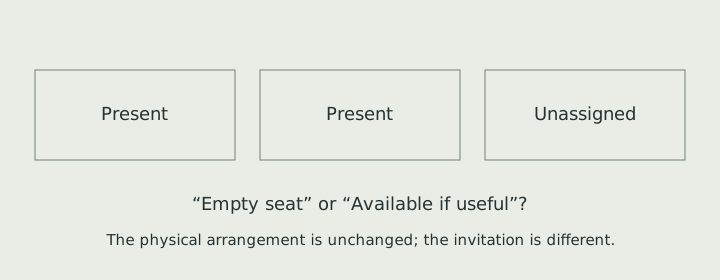
The diagram keeps the physical arrangement fixed and changes only the phrase. It does not show which phrase is better for every circumstance. It makes a smaller distinction visible: an absence can be described as a condition to explain, or an option someone may use.4
Leave the arrangement editable.
After the imagined meeting, we might count the unused papers and put the chairs away. That would record what remained, but it would not explain what anyone needed. A useful account would distinguish what was observed, what was guessed, and what could be asked next.5
The strongest revision was a sentence that admitted the arrangement could be changed.
Move a chair if you need to. Read first if speaking is not useful yet. Ask for the missing context. These are possible offers, not instructions to perform ease. Their value depends on whether the host can actually respond when someone takes them up.
The empty place therefore becomes less interesting as a symbol. It is not evidence of generosity, openness or failure. It is one part of an unfinished situation. The editorial task is to keep that incompleteness legible instead of improving it into a claim.
We can end the essay without filling the chair. The person who might use it need not arrive to complete our story. What changes is the responsibility of the person who made the offer: to explain it clearly, hear a different need, and allow the arrangement to be revised.6